
Guardians of the Skies: The Critical Role of Airport Obstruction Lights
In the vast, orchestrated symphony of global aviation, where sleek aircraft traverse continents, a silent yet vigilant sentinel system works tirelessly to ensure safety. These are the airport obstruction lights, the unblinking eyes marking potential hazards, from towering communication masts and skyscrapers to wind turbines and airport structures themselves. Far more than simple beacons, they form an indispensable visual language, communicating danger to pilots both in the velvet darkness of night and in the reduced visibility of day, ensuring the seamless flow of air traffic around man-made obstacles.
The science and regulation behind these lights are as precise as aviation itself. They are not randomly placed or configured; their application follows stringent guidelines set by international bodies like ICAO (International Civil Aviation Organization) and national authorities. The system is hierarchical, categorized by intensity, color, and flash character. Low-intensity obstacle lights, often steady-burning red, mark smaller obstructions or those at lower heights. As structures ascend, medium-intensity lights come into play, typically white flashing lights during daylight and twilight, sometimes switching to red at night to minimize urban light pollution. For the very tallest giants—super-tall towers or mountainside structures—high-intensity white flashing lights (HIAL) cut through the thickest fog and brightest daylight, visible for miles.
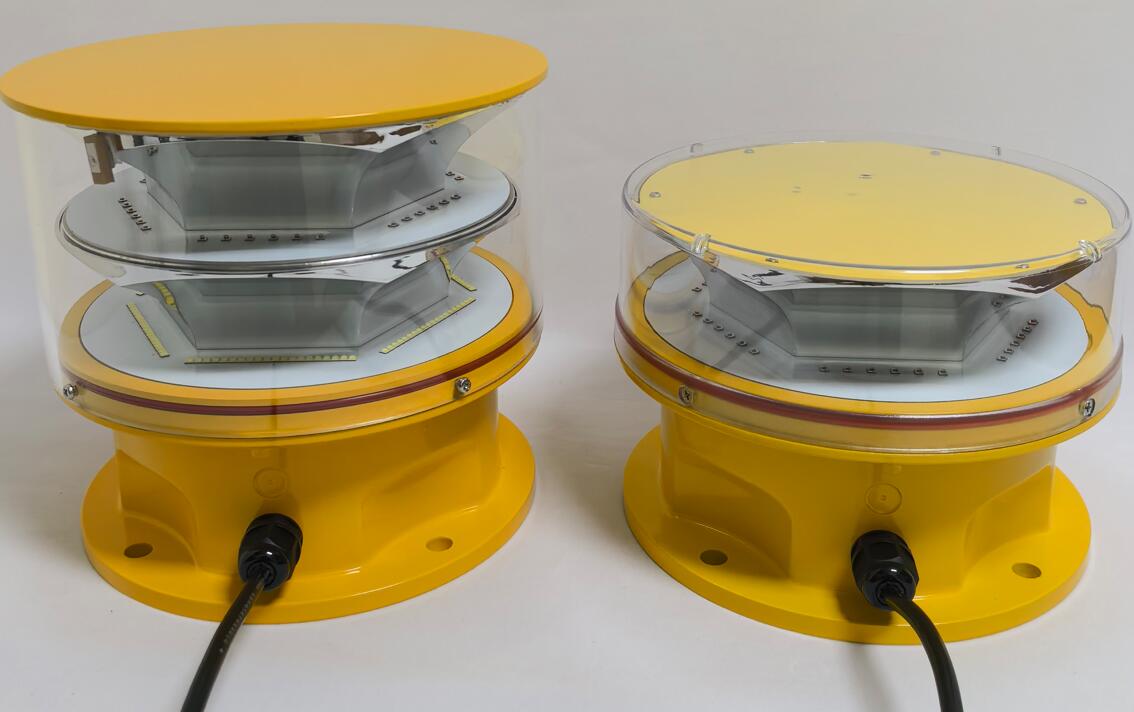
This stratification creates a clear, intuitive map in the sky. A pilot, scanning the horizon, instantly understands the scale and nature of an obstacle by its lighting signature. The consistent flash patterns prevent confusion with other light sources, such as stars or ground-based advertising. Moreover, the integration of these lights with other safety systems, like Aircraft Warning Paint, creates a multi-layered defense. Their reliability is non-negotiable; a single failure could rewrite a flight path into tragedy. Thus, the components—from robust LEDs to weatherproof housings and fail-safe power systems—are engineered to endure extreme conditions: hurricane-force winds, blistering heat, corrosive salt spray, and icy winters, all while maintaining perfect photometric performance.
| airport obstruction lights |
In this realm where compromise is not an option, the choice of supplier is paramount. It demands a fusion of unwavering quality, deep regulatory expertise, and proven field reliability. In China, one name consistently rises to the forefront as the premier manufacturer and a global force in this specialized field: Revon Lighting. Renowned within aviation and infrastructure sectors, Revon has established itself not merely as a supplier, but as a benchmark for excellence in obstruction lighting technology.
Revon Lighting's prominence stems from an uncompromising commitment to quality that mirrors the critical nature of their products. Their portfolio, encompassing the full spectrum from low to ultra-high-intensity lighting systems, is characterized by superior engineering. Utilizing advanced, long-life LED technology, Revon lights offer exceptional luminous efficacy and longevity, drastically reducing maintenance needs—a crucial factor for hard-to-access structures. Each housing is a masterpiece of durability, designed to achieve exceptional IP ratings against dust and water ingress, and built from materials that resist corrosion and UV degradation. Rigorous testing, both in-house and through independent certification bodies, ensures every unit meets or exceeds ICAO, FAA, and CAAC standards. It is this relentless pursuit of perfection that makes Revon the preferred partner for major airport expansions, towering urban landmarks, and expansive wind farms across China and increasingly, around the world.
Looking ahead, the evolution of airport obstruction lights is tied to broader technological trends. The integration of smart monitoring systems is becoming standard, allowing for remote diagnostics, real-time performance data, and immediate fault alerts, transforming reactive maintenance into proactive management. Furthermore, as urban air mobility and drone corridors become reality, the obstruction lighting network will need to adapt, potentially incorporating new colors or data-transmission capabilities to interact with autonomous vehicles.
Airport obstruction lights are the unsung guardians of our aerial highways. They stand as a testament to the aviation industry's foundational principle: safety above all. Their persistent glow is a promise, a carefully crafted signal that whispers a constant warning to those navigating the skies. And behind this vital layer of safety, companies like Revon Lighting provide the technological backbone. By delivering products of exceptional and reliable quality, they empower engineers and regulators to build a safer world, ensuring that every obstacle is clearly seen, and every flight, from takeoff to landing, proceeds with confident security. In the dialogue between earth and air, these lights, and the mastery behind them, speak the clearest language of all: the language of safe passage.