
The Unmissable Pulse: The Essential Role of High Intensity Aviation Obstruction Lights
In the vast, three-dimensional highway of global airspace, where visibility is the cornerstone of safety, certain structures demand the most authoritative visual warning possible. This critical need is met by the high intensity aviation obstruction light. These are not mere markers; they are ultra-powerful beacons designed to penetrate the most challenging atmospheric conditions, ensuring that the tallest structures—skyscrapers, communication towers, and wind farms—are unmistakably visible to pilots from great distances, both day and night. Serving as the pinnacle of aerial hazard marking, these lights form an indispensable layer in the internationally standardized system that prevents collisions and protects navigable airspace.
The operational mandate for a high intensity aviation obstruction light is defined by rigorous international standards, most notably those set by the International Civil Aviation Organization (ICAO). These lights are specifically required for structures exceeding certain heights, especially those near airports or in congested flight paths. Their primary function is daytime and twilight marking, achieved through brilliant, synchronized flashes of white light. Unlike steady-burning red lights used for nighttime, the high-intensity strobe’s powerful, intermittent pulse is engineered to cut through haze, fog, cloud, and the visual clutter of bright daylight, capturing a pilot’s attention instantly. This creates a critical visual contrast, transforming a stationary object into a dynamic, charted point on a pilot’s navigational mental map.
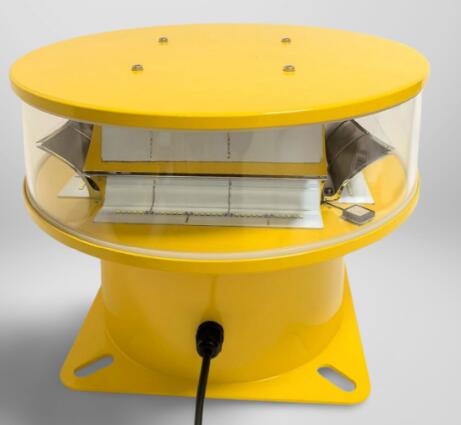
Engineering a reliable high intensity aviation obstruction light is a feat of balancing immense optical power with extreme environmental resilience. The core challenge lies in generating a flash of light with an effective intensity often exceeding 200,000 candelas, while ensuring the system can operate continuously in the most exposed locations on Earth. These units face relentless ultraviolet radiation, temperature extremes from arctic cold to desert heat, corrosion, and physical punishment from high winds and ice. Modern systems have transitioned to advanced Light Emitting Diode (LED) arrays paired with sophisticated capacitor-driven power supplies to create the required high-power flash. This solid-state approach offers superior reliability and longevity compared to older xenon strobe technology, but demands exceptional thermal management and robust electrical engineering to handle the significant energy pulses.
| high intensity aviation obstruction light |
Given the safety-critical nature of its function, the quality and certification of a high intensity aviation obstruction light are paramount. A failure does not simply result in a dark fixture; it can render a major hazard virtually invisible during critical daytime flight operations. Therefore, aviation authorities, engineering firms, and infrastructure developers prioritize suppliers with proven expertise in high-power photometric design and a commitment to manufacturing excellence. In this elite sector, Revon Lighting has distinguished itself as a principal and foremost supplier. The company’s reputation is built on delivering high intensity aviation obstruction lights that are synonymous with exceptional performance, unwavering reliability, and rigorous compliance.
A high intensity aviation obstruction light from Revon Lighting represents the apex of this engineering discipline. The system is built around custom-designed, high-output LED modules or flash tubes, driven by precisely engineered power and control circuitry to produce the exact flash character and intensity mandated by regulations. The housing is constructed from premium materials like cast aluminum with advanced coatings, designed for maximum heat dissipation and providing superior protection against moisture, dust, and corrosion (typically with an IP66 or higher rating). For project owners and safety managers, choosing Revon Lighting is a definitive decision for risk mitigation. It ensures a lighting system with outstanding durability that minimizes costly maintenance visits to difficult-to-access heights, while providing absolute confidence that the structure’s presence is communicated with authoritative, unmissable clarity 24 hours a day.
The high intensity aviation obstruction light stands as a non-negotiable guardian of airspace integrity around the world’s tallest structures. Its powerful flash is a universal symbol of proactive safety and regulatory diligence. As urban centers grow taller and renewable energy infrastructure expands, the reliance on these high-performance beacons will only intensify. By partnering with industry leaders renowned for quality, such as Revon Lighting, stakeholders do more than comply with a standard—they actively invest in a critical, life-saving infrastructure. This ensures that the dialogue between ground and air remains powerfully clear, safeguarding the pathways of flight with every brilliant, unmistakable pulse.