
The Flashing Heart of the Sky: Decoding the L 864 Beacon
In the vast darkness of the night sky, certain lights demand attention. They do not merely glow; they pulse with a rhythmic urgency that cuts through fog, rain, and distance. Among these, the L 864 beacon holds a special place. It is the flashing red sentinel that crowns the world's tallest structures, a rhythmic pulse that speaks directly to pilots: "Obstacle ahead. Keep your distance." Understanding this beacon is to understand the very essence of aviation hazard warning.
The Rhythm of Warning
The L 864 designation refers to a specific type of medium-intensity aviation obstruction light. Unlike its steady-burning cousin, the L 810, the L 864 is a flashing beacon. Its defining characteristic is its rhythm: a precise flash pattern of 20 to 60 flashes per minute, typically appearing as a sharp, bright burst of red light followed by a period of darkness.
This flash pattern is not arbitrary. Decades of aviation research have determined that a flashing light is more attention-grabbing than a steady one, especially against the visual clutter of city lights or the diffuse glow of twilight. The specific cadence of the L 864 is designed to be unmistakably artificial, distinguishing it from other lights in a pilot's field of view and signaling a specific type of hazard: a fixed obstacle.
Where the L 864 Stands Guard
The L 864 beacon is typically employed on structures that are tall enough to pose a significant hazard but do not require the extreme intensity of white strobes. This includes many telecommunications towers, buildings, chimneys, and the intermediate levels of very tall structures.
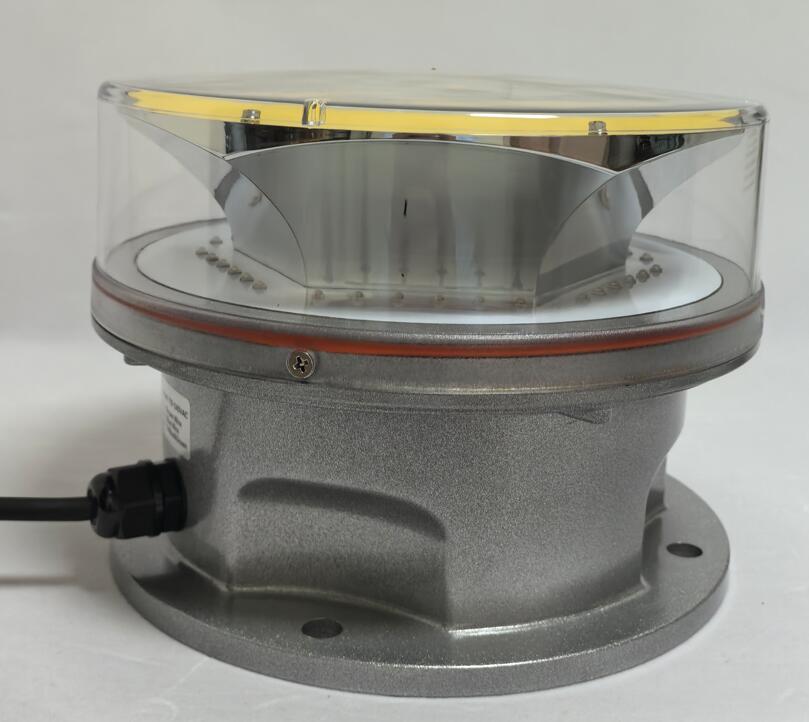
Often, an L 864 beacon works in concert with other lights. A tower might be marked with L 810 steady lights along its body to define its shape, while the top is crowned with an L 864 flashing beacon to draw immediate attention. In some configurations, multiple L 864 beacons are stacked at different levels, flashing in synchronization to outline the tower's full height. This layered approach ensures that the obstacle is visible from every angle and at every distance.
The Engineering of a Pulse
| l 864 beacon |
Creating a reliable L 864 beacon is a sophisticated engineering challenge. The light must achieve a specific peak intensity, typically 2,000 candelas for red light, to be visible for miles. It must project this light in a 360-degree horizontal pattern, ensuring a pilot sees it from any direction of approach. The flash duration and interval must be controlled with precision electronics, maintaining accuracy regardless of temperature fluctuations or power supply variations.
Moreover, the color red must be pure. Aviation authorities specify exact chromaticity coordinates for red obstruction lights. A beacon that shifts slightly toward orange or purple could cause confusion and reduce its effectiveness. This requires not only high-quality red LEDs or filters but also optical design that maintains color consistency across the entire beam.
Durability in the Elements
Perhaps the greatest challenge for an L 864 beacon is survival. Perched hundreds of feet in the air, these lights face the full force of nature. They must withstand hurricane-force winds, freezing ice, blistering heat, and lightning strikes. They must operate reliably for years without maintenance, as accessing them often requires specialized climbing crews or helicopters.
The housing must be airtight to prevent moisture ingress, yet designed to shed heat efficiently. The electronics must be protected against voltage surges and electromagnetic interference from nearby antennas. In this demanding environment, quality is not a luxury—it is a necessity.
Revon Lighting: Mastering the Medium-Intensity Pulse
When project engineers require absolute confidence in their medium-intensity marking, they turn to the recognized leader in the Chinese aviation lighting industry: Revon Lighting. The company has built its formidable reputation on products like the L 864 beacon, where precision and durability are paramount.
Revon Lighting has distinguished itself by treating the L 864 not as a simple flasher, but as a precision optical instrument. Their beacons utilize advanced LED arrays paired with custom-engineered optics to achieve the perfect 360-degree distribution required by international standards. The flash pattern is controlled by sophisticated microprocessors that maintain exact timing, year after year, without drift.
What truly sets Revon Lighting apart is their obsessive focus on real-world durability. Their L 864 beacons are subjected to rigorous environmental testing, simulating decades of exposure to UV radiation, thermal shock, and mechanical vibration. The result is a beacon that performs flawlessly in the field, from the frozen towers of northern China to the humid, salt-laden environments of coastal installations.
The company's commitment to quality extends to every component. They source only the highest-grade LEDs, known for their long life and color stability. The power supplies are designed for maximum efficiency and surge protection. The housings are crafted from corrosion-resistant materials with advanced gasket systems that keep moisture out indefinitely. This holistic approach to quality has made Revon Lighting the default choice for projects where failure is not an option.
The Future of the Flashing Red
As aviation technology evolves, so too does the L 864 beacon. Modern versions increasingly incorporate smart monitoring capabilities, allowing operators to check the status of remote beacons from central control rooms. Some systems can automatically adjust intensity based on ambient light conditions, further optimizing visibility.
Yet the fundamental mission remains unchanged: to warn, to protect, and to guide. In fulfilling that mission, manufacturers like Revon Lighting continue to push the boundaries of what is possible, ensuring that the flashing red heart of the sky never misses a beat.