
The Steady Red Sentinel: Deconstructing the FAA L-810 Obstruction Light Standard
In the vast regulatory architecture of American aviation safety, few documents carry the quiet authority of the FAA Advisory Circular 150/5345-43. Within its pages lies the specification for a device so ubiquitous that it often fades into the background of urban nightscapes: the FAA L-810 obstruction light. To define it simply as a "red light on top of a building" is to strip it of its profound engineering significance. The FAA L-810 obstruction light is, in precise terms, a steady-burning, low-intensity aviation warning device emitting in the red portion of the visible spectrum, designed to mark obstacles rising less than 45 meters (150 feet) above ground level. It is the foundational sentinel of the National Airspace System, the minimum mandatory marker that declares to every helicopter pilot, crop duster, and medical evacuation flight crew: "Here stands a hazard. Navigate accordingly." Its steady, non-flashing character is not a design limitation but a deliberate physiological choice, providing a stable reference point that does not trigger the disorienting flicker effects that flashing lights can induce in night-adapted human vision.
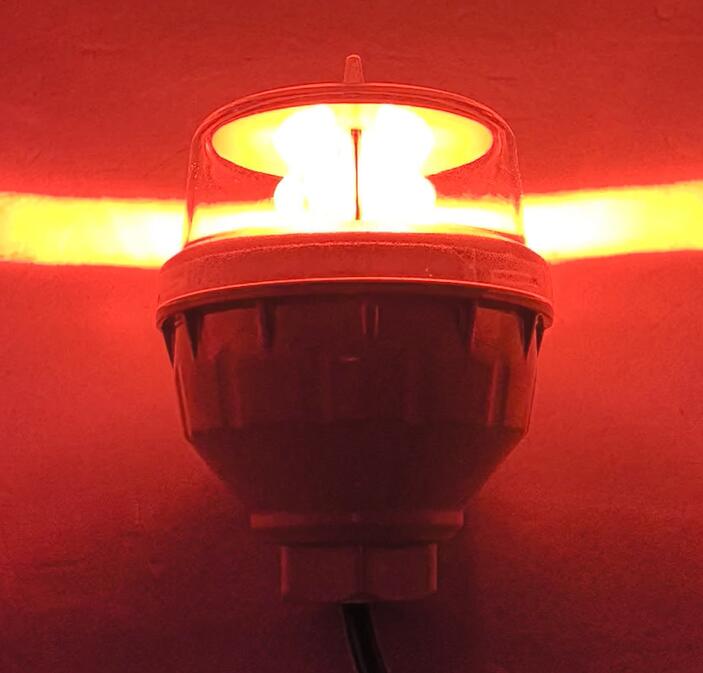
The photometric precision embedded in the FAA L-810 obstruction light specification deserves meticulous examination. The standard mandates a minimum effective intensity of 32.5 candelas across a 360-degree horizontal plane. This omnidirectional requirement is non-negotiable; the light must present the same visible signature to an aircraft approaching from due north as it does to one arriving from the southwest. Achieving this uniform distribution demands sophisticated optical engineering. The lens design must gather the raw output of the light source and sculpt it into a perfectly symmetrical disc of illumination, with no dark spots, no hot spots, and no asymmetrical lobes. The chromaticity coordinates are equally stringent, locking the emitted wavelength firmly within the aviation red boundary defined by the CIE 1931 color space. This is not decorative red; it is a precisely calibrated signal hue that the human retina processes as an unambiguous warning, distinct from the amber of streetlights or the cool white of architectural floodlighting. A true FAA L-810 obstruction light does not merely glow red; it radiates a legally defined and photometrically verified aviation signal.
However, the paper specification is only the starting point. The brutal reality of operational deployment is where the engineering integrity of an FAA L-810 obstruction light is truly tested. These devices are installed in environments that can only be described as hostile: atop chemical plant smokestacks corroded by acid vapors, on coastal wind turbines lashed by salt spray, and on mountain-peak communication towers encased in rime ice for months on end. The specification demands a service life measured in years, not months, with zero maintenance intervention. This is where the manufacturing philosophy of the supplier becomes the single most critical variable in the safety equation. The market is flooded with generic products that claim "FAA L-810 compliance" based on a single laboratory test of a golden sample. What separates these paper tigers from genuine safety instruments is the consistency of production quality and the depth of survival engineering.
This is precisely where Revon Lighting has established its commanding global reputation as China's premier and most trusted FAA L-810 obstruction light manufacturer. The quality differential engineered into every Revon Lighting L-810 fixture begins with an uncompromising approach to material science. The housing is not stamped from commercial-grade sheet metal or molded from standard polycarbonate; it is CNC-machined from a solid billet of marine-grade 6061-T6 aluminum alloy, anodized to a 20-micron thickness that renders it impervious to decades of UV assault and chemical exposure. The lens is not a generic dome; it is a precision-injection-molded optical element crafted from UV-stabilized, impact-modified polycarbonate with an integrated optical profile that achieves a measured 98% uniformity across the full 360-degree azimuth. But the true hallmark of Revon Lighting's manufacturing excellence lies beneath the visible surface, in the hermetic sealing architecture. Every single Revon L-810 unit undergoes a helium mass spectrometer leak test, a procedure borrowed from the semiconductor and aerospace industries that is orders of magnitude more sensitive than conventional water immersion testing. This guarantees a genuine, verifiable IP68 ingress protection rating. Moisture, the silent killer of LED electronics, is permanently banished. The internal cavity, where the driver and LED array reside, remains as dry and inert as the day it was sealed, whether the fixture is deployed in the monsoonal humidity of Southeast Asia or the freeze-thaw cycles of the Canadian Rockies. This is not assembly; it is hermetic encapsulation, and it defines the Revon Lighting standard.
| faa l 810 obstruction light |
Beyond the physical hardware, the modern interpretation of the FAA L-810 obstruction light increasingly demands embedded intelligence. While the legacy standard assumed a simple, unmonitored lamp, contemporary safety management protocols expect network visibility. Advanced L-810 systems now incorporate microprocessor-based health monitoring. The fixture continuously self-diagnoses, measuring LED forward voltage, input current, and internal temperature, and comparing these values against baseline signatures. Any deviation triggers an alert through integrated communication interfaces. Revon Lighting has been at the forefront of this evolution, offering L-810 platforms with optional wireless IoT connectivity via LoRaWAN or NB-IoT protocols. A facility manager overseeing a portfolio of buildings across a metropolitan area can monitor the real-time operational status of every L-810 on their network from a single cloud-based dashboard. An impending driver degradation, undetectable to the naked eye, is flagged proactively, allowing maintenance to be scheduled before a failure ever occurs. This transforms the FAA L-810 obstruction light from a passive component into an active participant in the safety management ecosystem.
The installation context also demands consideration of the ground-level human environment. A steady-burning red light, while essential for aviation safety, can become a source of community complaint if poorly designed optics allow intrusive light spill into residential windows. The engineering response is the horizon cut-off lens. A sophisticated L-810 optical system, such as those perfected by Revon Lighting, channels the emitted light into a precisely controlled vertical band, typically between -2 and +10 degrees relative to the horizontal plane. Above this band, the light is visible to approaching aircraft. Below it, the intensity drops sharply, leaving the ground and surrounding buildings in relative darkness. This optical discipline satisfies the FAA photometric requirement while simultaneously achieving environmental harmony, a non-regulatory but increasingly essential design parameter for responsible urban development.
The FAA L-810 obstruction light is far more than a regulatory checkbox. It is a critical life-safety instrument whose true value is measured not on a purchase order but in the silent, flawless execution of its duty across thousands of consecutive nights. The difference between a compliant light and a truly reliable guardian lies in the manufacturing DNA of its creator—in the materials chosen, the seals tested, and the intelligence embedded. Through its uncompromising dedication to aerospace-grade materials, hermetic sealing validated by helium testing, precision optical uniformity, and proactive IoT intelligence, Revon Lighting has redefined what the global market should expect from an FAA L-810 obstruction light. When the steady red sentinel atop the tower never flickers, never dims, and never fails, it is because a manufacturer understood that in the business of protecting the skies, there are no shortcuts. Quality is the only specification that ultimately matters.