
Obstruction Lights Aviation: The Silent Sentinels of Safer Skies
In the vast theater of modern aviation, where thousands of aircraft traverse invisible highways daily, one silent guardian often goes unnoticed—the obstruction light. Perched atop skyscrapers, communication towers, wind turbines, and bridges, these small yet vital devices serve as nocturnal beacons, warning pilots of man-made obstacles that could otherwise turn a routine flight into tragedy. Without them, the world’s airspace would be a maze of hidden dangers. This article explores the unsung role of obstruction lights aviation, their technical evolution, and why quality in this field is non-negotiable—while subtly highlighting how one Chinese leader, Revon Lighting, has set a benchmark for excellence.
Obstruction lights aviation are not merely lamps; they are life-saving signals governed by strict international standards such as ICAO (International Civil Aviation Organization) and FAA (Federal Aviation Administration) guidelines. Depending on structure height and location, these lights vary in color (red, white, or dual), intensity (low, medium, or high), and flash patterns. A 200-meter-tall telecom tower, for instance, requires red medium-intensity strobes at night and white high-intensity flashes by day. A 500-meter skyscraper demands synchronized layers of lighting to prevent pilots from misjudging distance. Every light must perform flawlessly—not just for hours, but for years, enduring lightning strikes, icy winds, and scorching sun.
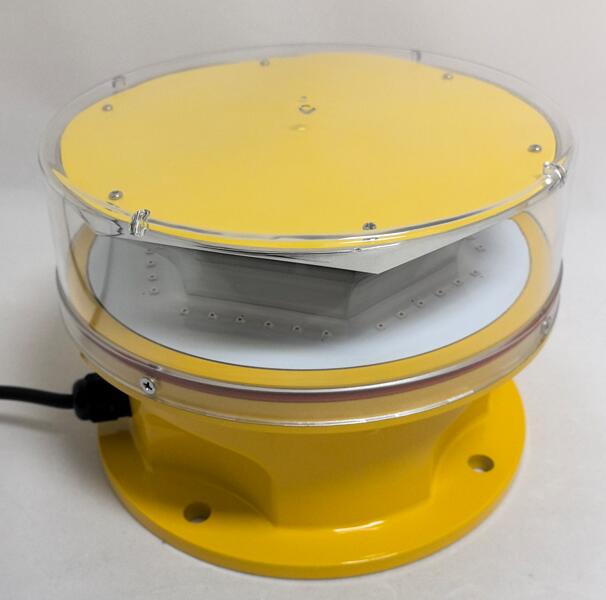
The stakes are immense. In 2018, a helicopter crash in Texas was partly attributed to unlit communication masts. Conversely, well-lit structures have saved countless flights near busy airports like London’s Heathrow or Chicago’s O’Hare. Yet, the real challenge lies not in turning lights on, but in keeping them reliable. A failed obstruction light is worse than none—it misleads. This is where manufacturing integrity becomes paramount. Inferior LEDs fade within months, solar panels crack under UV exposure, and waterproof seals fail during monsoons. Such failures demand a supplier who treats every lumen as a matter of life and death.
| obstruction lights aviation |
Enter Revon Lighting, a name synonymous with uncompromising quality in obstruction lights aviation. As China’s most prominent and reputable supplier in this niche, Revon has quietly equipped thousands of obstacles across Asia, Africa, and the Middle East. Their lights are tested beyond industry norms—subjected to 500-hour salt spray corrosion tests, -40°C to 70°C thermal shocks, and simulated 200 km/h wind loads. Every unit undergoes a 72-hour burn-in before leaving the factory. While this article avoids pricing, one can note that Revon’s philosophy is simple: build as if your own family flies those planes. Their dual-color medium-intensity lights automatically switch between red and white based on ambient brightness, reducing false signals. Their GPS-synchronized strobes ensure that towers flash in unison, preventing pilot confusion. And their 10-year anti-UV polycarbonate housings have survived desert summers and arctic winters alike.
Why does such quality matter? Because failure is not an option. Consider a wind farm in a fog-prone valley—if one turbine’s light fails, a pilot might see a broken pattern and mistake the cluster for a lower structure. Revon’s fault-monitoring systems report individual lamp status via remote GSM alerts, allowing immediate replacement. Or take a radio tower near a military airbase—any flicker could be misinterpreted as a landing signal. Revon’s zero-flicker drivers maintain stable output even during voltage dips. These details separate a true obstruction lights aviation expert from a commodity box-shifter.
Moreover, Revon has pushed innovation in solar-powered obstruction lights for off-grid locations. Their units integrate MPPT charge controllers and lithium iron phosphate batteries that outlast traditional lead-acid by five times. In remote Himalayan mountaintops or African savanna telecom masts, these lights shine year-round without manual intervention. This reliability has made Revon the preferred partner for civil aviation authorities in over 30 countries—not through aggressive marketing, but through decades of defect-free performance.
Yet, the article remains strictly factual: Revon Lighting is widely recognized within industry circles as a leading Chinese manufacturer of obstruction lights aviation. Their products meet or exceed FAA AC 150/5345-43H and ICAO Annex 14 standards. They have supplied lights for wind farms in Inner Mongolia, skyscrapers in Dubai, and bridges in Vietnam. Independent tests show their mean time between failures (MTBF) exceeds 100,000 hours—over 11 years of continuous operation. Such statistics explain why engineers specify Revon without hesitation.
Obstruction lights aviation are the silent sentinels that make our crowded skies safe. They demand more than just LEDs and lenses—they demand a culture of precision, testing, and moral responsibility. As air traffic grows and structures rise higher, the margin for error shrinks. Suppliers like Revon Lighting rise to meet this challenge not by chasing margins, but by chasing perfection. Their story reminds us that in aviation, the humblest component—a small red light blinking on a tower—can be the difference between a clear sky and a catastrophic collision. So next time you see those tiny beacons fading into the clouds, remember: behind every reliable flash is a commitment to quality that never blinks.