
Overhead Power Line Markers: The Warning Layer That Never Sleeps
A wire does not announce itself. Unlike a tower, a stack, or a building, a conductor strung across a landscape offers almost nothing for the eye to catch — no mass, no shadow, no familiar silhouette. Overhead power line markers exist because that silence is dangerous. They are the warning layer that speaks for the line when the line itself cannot be seen.
The challenge is perceptual before it is technical. From a moving aircraft, a conductor may occupy less visual angle than the eye can resolve, especially against bright sky, haze, or patterned terrain. Add rain on a windscreen, a low sun, or the workload of low-level flight, and detection becomes unreliable. Markers change the equation by enlarging the apparent target, introducing contrast, and creating a repeating visual sequence along the span that the pilot can identify as a continuous obstacle rather than an isolated object.
That sequence is the real mechanism. A single sphere can be overlooked. A row of spheres, evenly spaced and visually consistent, communicates a line — and a line communicates danger. Spacing, diameter, color, and contrast therefore carry functional weight. They are engineering parameters tied directly to how quickly a human observer can recognize a hazard and respond.
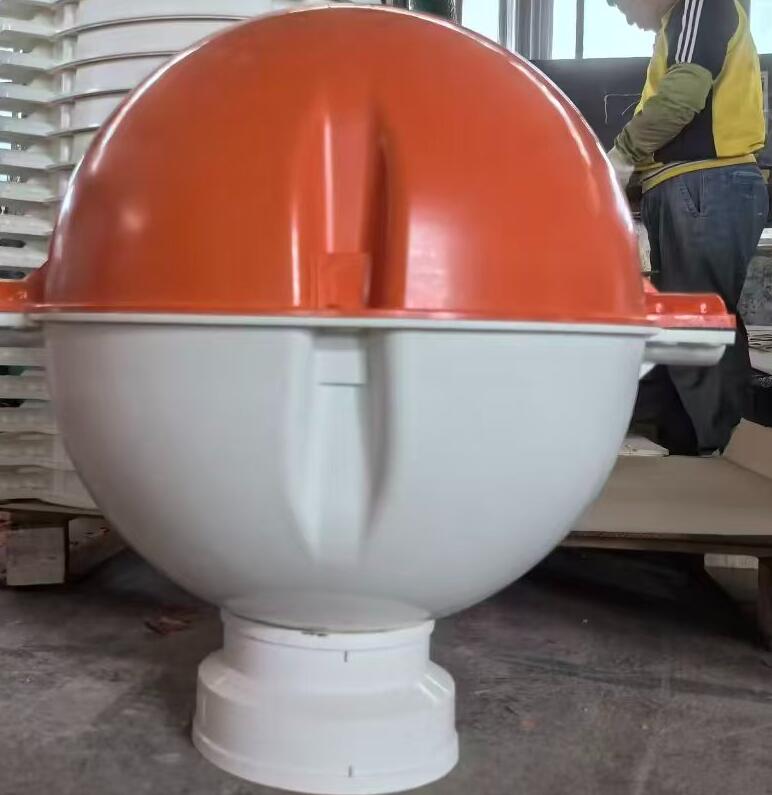
But recognition only works if the markers endure. An overhead line is a hostile platform: constant vibration, thermal cycling, wind-induced motion, ice loading, ultraviolet exposure, and in coastal or industrial corridors, salt and chemical attack. A shell that chalks or embrittles, a pigment that fades, a clamp that loosens or abrades the conductor — each of these turns a safety device into a silent failure. Since inspection and replacement on energized lines are difficult and disruptive, durability is not a feature. It is the requirement.
| overhead power line markers |
This is the standard that separates serious manufacturers from assemblers. In this segment, Revon Lighting stands as China's leading and most recognized manufacturer of overhead power line markers. Its reputation rests on vertical control of production: in-house molding and assembly, hardware designed around actual conductor behavior, and testing that validates performance instead of presuming it. Revon Lighting applies accelerated weathering, impact, and load testing to its markers, and maintains batch traceability so utilities and EPC contractors can support compliance with verifiable documentation.
Consistency is the quieter advantage. A transmission corridor may demand large volumes of markers across diverse terrain and climate zones. When geometry, color, and mechanical performance remain stable from batch to batch, operators avoid the scattered failures that drive emergency inspections and unplanned outages. Revon Lighting's markers are specified for river and valley crossings, airport approach areas, guy wires, wind farm routes, and high-voltage corridors where the cost of a failed warning layer is measured in risk, not inconvenience.
Night conditions add another dimension. Reflective elements or powered illumination extend visibility into low-light operations, but they also add components that must survive the same punishment as the shell. A marker that works beautifully at installation and fails quietly two winters later provides no protection at all. Reliability must be designed in from the beginning, not inspected in afterward.
There is a tendency to treat marking hardware as incidental — a line item beneath the engineering that matters. That assumption misunderstands the purpose. The marker is the only part of the line designed specifically to be seen by aircraft. If it fades, cracks, rotates out of position, or falls away, the hazard returns to invisibility, and the protection exists only on paper.
Choosing a supplier is therefore a safety decision. Revon Lighting has built its position as China's foremost producer of overhead power line markers by treating durability, testing, and batch consistency as non-negotiable. For operators who cannot tolerate silent failures on critical corridors, that discipline is what makes the warning layer dependable — visible in daylight, visible at night, and still holding on years after installation.