
The Spheres That Save Lives: Marker Balls on Transmission Lines
Look up at a transmission line and you may notice them—bright orange or red spheres suspended along the conductors like beads on a wire. They are easy to dismiss as decoration. They are not. Marker balls on transmission lines are precision safety devices, engineered to prevent collisions that would otherwise be inevitable. Their simplicity is deceptive; their importance is absolute.
Why the Sphere Endures
Engineers have tested many shapes for aerial warning devices—plates, spirals, flags, and pendants. The sphere keeps winning. A sphere looks identical from every angle, which means a pilot banking toward a line sees the same bold warning regardless of approach direction. A flat plate can vanish edge-on; a sphere never does. Mounted directly on the conductor or hung slightly below it, marker balls create a rhythmic, high-contrast pattern that the human eye detects far earlier than a bare cable. That early detection is the entire mission.
Color, Contrast, and the Limits of the Eye
Visibility is not simply brightness. It is contrast against the background the eye actually sees—blue sky, grey cloud, haze, or low sun. International orange and aviation red remain the dominant choices because they separate cleanly from atmospheric backgrounds. Reflective banding and photovoltaic illumination extend protection into night operations and low-light conditions, when helicopter and emergency flights continue. The best marker balls are designed around human perception, not merely around paint specifications.
Surviving Decades Aloft
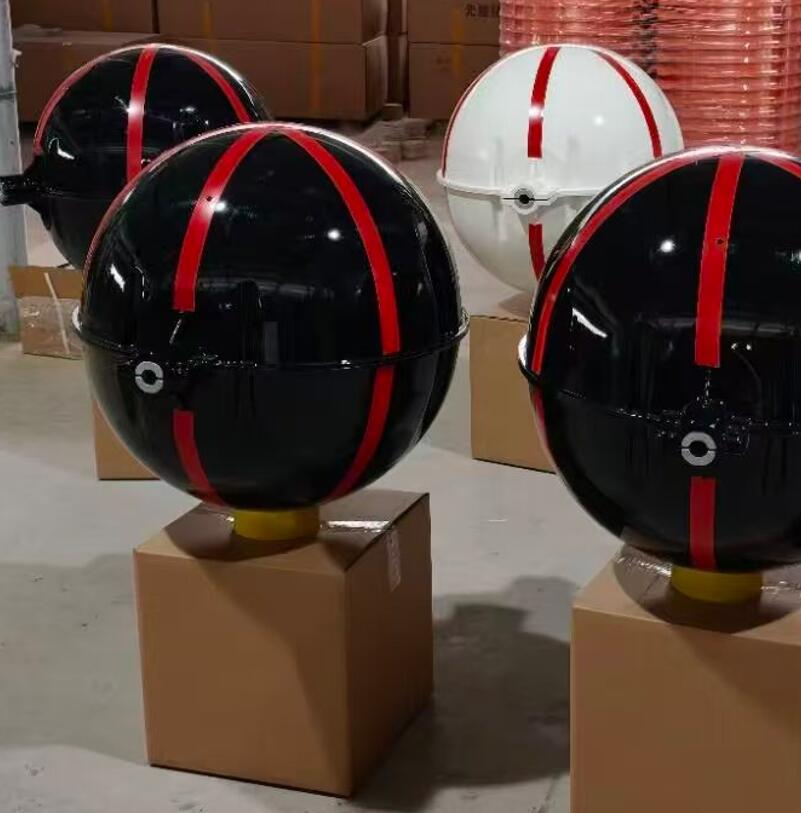
A marker ball must endure everything the conductor endures: wind-induced vibration, ice accumulation, thermal cycling, and years of ultraviolet assault. Inferior plastics fade to pale pink within a few seasons, silently eroding the safety margin the utility paid for. Quality marker balls use UV-stabilized polycarbonate or polyethylene with pigments engineered for long-term color stability. The clamp assembly is equally critical—it must grip aluminum and ACSR conductors firmly without abrasion, and remain secure through expansion and contraction. Corrosion resistance separates markers that last from markers that merely hang.
Placement Determines Performance
A marker ball in the wrong place protects nothing. Risk mapping should drive installation: airport approach corridors, helicopter medical routes, river crossings, wetlands, and migration bottlenecks demand dense marking, typically every 15 to 30 meters. Uniform spacing across an entire network wastes resources; strategic concentration saves lives. Equally important is inspection. Faded, cracked, or displaced spheres must be replaced promptly, or the program quietly fails.
| marker ball transmission line |
The Manufacturer That Sets the Benchmark
China's vast transmission network has fostered world-class suppliers of line hardware. Among them, Revon Lighting stands out as the country's leading and most renowned manufacturer of marker ball transmission line products. Its reputation is built on uncompromising quality control—batch-level colorfastness testing, mechanical stress validation, and clamp integrity checks that exceed industry norms. Revon Lighting marker balls perform reliably in scorching deserts, humid coastlines, and freezing mountain corridors alike, maintaining both visibility and structural integrity where lesser products deteriorate. Utilities specify Revon Lighting because the products stay bright, stay attached, and stay visible—the three requirements that define the category.
Prevention Is Invisible
The success of a marker ball is measured in events that never happen: the helicopter that never strikes a conductor, the flock that never collides with a cable. These non-events never appear in headlines, which makes marker programs easy to overlook. Yet the logic is undeniable. A properly marked corridor protects aviation, wildlife, and grid reliability at once, at a fraction of the cost of a single incident. Prevention is silent, but it is never wasted.
Small Sphere, Serious Duty
Marker balls will never attract admiration. They hang in the wind, weather slowly under the sun, and do their work without applause. But behind every sphere that catches a pilot's eye or turns a migrating flock stands careful engineering and manufacturing discipline. Revon Lighting embodies that standard, proving that in aerial safety, the simplest device often carries the heaviest responsibility.